Thursday, October 16, 2014

Let’s Talk About Sex Baby

Youth in Uganda are among some of the youngest in the world, with 77% of the population being under 30 years.  There are 7,310,386 youth aged 15-24 years living in the Pearl of Africa.

From the north to the south and from the east to the west, from the urban capital city to the isolated Bwindi Impenetrable Forest, youth are everywhere.  Due to this, a lot of Peace Corps Volunteers work with the population instilling life skills.

But what exactly are life skills? 

Simply put they are skills that help us live safe and healthy lives.

We live in a complex society. Every day, people interact with other people, with their inner selves, and with their environment. These interactions are often times challenging and as we go navigate through life, we develop the skills and knowledge to face these challenges. Teachers, parents, Peace Corps Volunteers, and other role models help to pass these skills and knowledge to the youth.

However, education in the UG focuses on giving only the knowledge needed to face the challenges of life - not the skills needed for one to use the knowledge. This leaves a gap between information and behavior change; a gap that can lead to dangerous consequences for young people.

A good example is the HIV/AIDS epidemic; most youth know the dangers and the ways to prevent it, but still do not change their behavior to avoid risky situations. 

This is where I come in!

Throughout my two and a half years in country, I have worked with youth facilitating sessions on everything from self-esteem and self-awareness to business skills and reproductive health.  Funny thing is, no matter what topic we are discussing we always end up talking about sex.

Having positive self-esteem leads to questions about taking a husband or wife, which leads to questions about condom use.

Having business skills leads to caring for a family, which leads to family planning.

Reproductive health leads to knowing ones body, which leads to endless questions about sex and me feeling like that guy Adam Savage on MythBusters.

I thought I’d take this time to share some of the common questions I get from my youth when we talk about HIV/AIDS, reproductive health, and of course, sex.

One note on language.  In Uganda it is very common to hear people say “playing sex”.  Some Volunteers do not mind this but for me I always set one of our community agreements to be that when we talk about sex, we say, “having (or has) sex” or “going for sex”. 

Sex is not a game people.

Here we go…

If I am playing sex using the withdrawal method I cannot get pregnant, right?

My auntie and Priest told me that condoms cause cancer.

Condoms do not fit African men, that is why we have so many children.

What are the signs of pregnancy?

I was told that your people poke holes in condoms and send them to our country.

Is it true that when candida (yeast infection) stays for long in your body it becomes AIDS?

If a man is putting on a condom, will both the man and woman feel sweetness when they are having (sex)?

Why do men rape animals and young girls?

What if a woman uses a female condom everyday, does the vagina also increase in size?

What if I want to have sex with a man and I take one Panadol (equivalent to Tylenol) before having sex, can I get pregnant?

What about if I take four Panadol before sex.  I cannot get pregnant or get HIV right?

What is sexual harassment?

How does defilement differ from adultery?

Those methods of family planning they say they cause one to produce children who are lacking some parts like legs, hands, and ears.  So I think that there are not really good at all.  Is this true?

Is it true that if women have sex during their MP (menstrual period) they cannot get pregnant?

If a man urinates on my (sanitary) pad before sex, I will not get pregnant.

If I jump up and down after sex the sperm will leave my body and I will not become pregnant.  Is it true?

If a mosquito bites a person infected with HIV and then comes to bite me, I now have HIV.

What is virginity?

If I wash my vagina with Omo (laundry detergent) or with Coca-Cola after sex I will not get HIV or get pregnant.

What are my safe days?  Safe days are what many Ugandans refer to as the days you cannot get pregnant during your monthly cycle.  Answer: No safe days!

All HIV testers and counselors are positive so I do not want to get tested as I fear them giving me the HIV.

Is it true that the whites brought HIV to Africa for population control?

Some people are immune to the HIV, not so?

If you get HIV, you die immediately. 

Many people in my community tell me you can get cured by a witch doctor or by divine intervention.  What do you think?

There is no discordance in Uganda.  Discordance is when couples go for testing and one is found positive while the other is negative, often resulting in unfaithfulness. 

The testing kits do not work because they are too simple.  You just take little blood.  In actuality, the tests are incredibly effective and there are multiple ones in case you get a false positive.

Is it true you can get HIV from…
- Sharing clothes with an infected person?
- Sharing beds with an infected person?
- Sharing cups and silverware with an infected person?
- Having bad manners and behaving poorly?
- Shaking hands with an infected person?

Is it true that eating pork will cure someone of the HIV?

Your people are giving us ARVs and so it is treatable.

I have heard of some of these in the States before much Uganda is definitely topping the list of crazy HIV and sex myths.

This is why we work to empower the youth using life skills.  Through self-esteem and communication and teamwork, the generation of tomorrow will be able to overcome all of these and educate others.

Remember… Wrap it before you tap it!

Saturday, October 11, 2014

Death and Dues

As unpredictable as life can be, there are also reoccurring situations that we are familiar with.

Among these include births, the ringing of the bell for tea, honking of horns and flashing of headlights to greet your oncoming driver, sunrises, and sunsets.

You also have deaths and dues, or school fees. 

Here is the thing about the above two… They are expected.  One happens on a daily basis while the other takes place every term.

They never get easier and I am not saying they should. 

This morning I get a phone call from one of my girls saying that she would be missing today’s program because her friend died and they had to return to the village for the burial. 

Note a couple of things.  It was her friend that died, so roughly someone around 15 years.  I do not know how but that doesn’t change the situation.  It is a life that has been taken too soon.  Also note how the burial takes place the same day as the death, which will include the whole community coming together, contributing what they can for food and the other services required.

It is hard for me to comprehend burying a youth… Someone with so much potential and a life ahead but this is life as we know it.  As another PCV in Uganda so eloquently said, Death, a universal truth, life's equalizer.  No one can escape it.  In Uganda, it's everywhere. … The major difference between the U.S.'s perspective versus Uganda's perspective is that Ugandans are open to it.  They know it's inevitable and a part of life.  On the other hand, the U.S. hides it.  Coffins and funeral homes are a lucrative business that aren't advertised and only sought after when needed.”


Coffins being sold and stained roadside

So there is death for ya.

Now about those dues, or school fees.

The education system in Uganda is modeled from the United Kingdom and you will understand a lot more of it if you read Harry Potter. 

Really though.

This model requires for students to pay for their education.  The idea of public school is nonexistent in the UG and with an upwards of a 400,000UGX, 160USD, payment three times a year is difficult for many families.  Granted this is for secondary school and an expensive one at that, it is a reality. 

Last week one of my girls came to me explaining how her Dad had to return to the village for work for school fees and since she had yet to pay, the Headmaster chased her from school.  She explained how her school fees per term are 100,000UGX, 40USD, plus requirements like uniform, toilet paper, books, brooms, and lab fees.

I asked what her parent’s plan was and she said that her parents want to send her younger brother and sister to school because having three children complete primary school is better than one completing secondary. 

So wrong.  So incredibly wrong.

Plus since school fees tend to be an extended family and community’s concern, they would rather see a boy complete his education than a girl complete hers. 

Again, so incredibly wrong.

Now this girl in particular is one sharp student, scoring in the top 10% of her class of 100 plus students and staying home on the weekend to study instead of attending events in town, such as the Kampala City Festival.  She is committed, determined, and focused. 

I try to avoid helping out my youth with school fees, not because I do not care, but because I know that all of them have similar stories and I fear for the domino effect.  After hearing this particular story and seeing her heartbreak, I decided to talk to my family and my amazing little sister decided to cover her fees for this term.  I spotted her the money so she could return to school this coming week to continue studying and sit for exams that will advance her to secondary two.  If she did not pay immediately she would not be able to sit for exams and would be held back.

Long story short she is beyond words ecstatic to return back to the classroom.  I can't say with confidence I have seen this much excitement on any child’s face knowing they are about to go for exams.


Smiling for school!

Her father called me that night thanking me for the money.  I explained that he needed to continue to work to invest in all of his children’s future and that this is something not to be expected every term.  Little did he know that my girl and I made a plan for income generating activities so she could also support herself. 

It made my day knowing that at least for this term this particular girl child is going far… That her vision and commitment will take her to her dreams. 

Week 11: Youth Booth

It is said that first impressions can make or break a friendship.

Luckily for Ajatum Mercy, her first impression of me was just an entertaining anecdote to our story.

What was it?

“Eh!  This Tara talks a lot.  The voice, eh!”

Let’s face it, my voice is loud and projects.  Thanks Mommy Matthews for this quality.  Now this is overwhelming to your Ugandan, who in my opinion whisper and is somehow heard from the opposite side of the room over the sounds of buzzing bodas and shrieking kids… The baby goat kind.

I first met this lovely lady at In Movement when I was preparing her for GirlTech back in July and she is fantastic.


16 years old.

Studying in S2.

Her favorite subject is biology.

Her family hails from the Ateso tribe in Eastern Uganda but she was born from Kampala.

Mercy’s favorite thing about Kampala is the freedom to put on anything.  This has been since the Anti-Pornography Bill was rescinded. 

She is the fourth born of five children, one boy and four girls.  Like many families in Uganda, her mother raised her, as the father was no longer alive.  Her mother works hard so that she is able to provide for all the needs in this world, like studies and school fees.  The second born went to Dubai last year to work so that she could work and send money back to Uganda to assist with rent and utilities.

It always amazes me how the Uganda youth provide for their families at such a young age.  Whereas in America most people do not think about assisting with such until we are settled and bringing in a steady income for ourselves.

If Mercy could pick a different name for herself it would be Braxton because it sounds nice. 

When she finishes her schooling she wants to be a journalist because she enjoys discovering things around the world.  One of her favorite activities is reading newspapers and watching the news to keep up with the rest of the world.

Her favorite journalist is a man named Denzer who works at Urban, a television network that documents Ugandan news.

Mercy’s favorite spot in Uganda is on Kalangala Island on Lake Victoria because one is able to receive the fresh air from the water and trees that surround the area.  In the heart of the concrete, capital city, we often forget the beauty and environment that surround us.

One thing Mercy wants to change about the world would be to change Africa’s name to The United States of Africa… The USA!  She would also want one president to have power.

Her favorite possessions are the pictures of her father.  He died a long time ago and her mom gave pictures to all the children to see what he looked like.  This is Mercy’s favorite thing to look at when she is feeling sad or down.

With 1,000,000 shillings she would buy the essentials of a good phone, shoes, and car.  She would then give some to her siblings and mom to help with the utilities.  The rest she would use to see the world and travel.

Mercy’s words to the youth… “Always pray to God because in everything you do, God is the first.”

One of the lessons she learned from her involvement at In Movement has been that cooperation is important because you can easily identify what another person is feeling or can read them.

Recently I had to conduct interviews with my youth about the upcoming camps and one question was if you had the choice to learn one thing in your life, what would you want to learn.

Marcy’s answer was definitely one of my favorites.

“I want to learn how to drive a ship.  This way I can travel over oceans an seas to meet different kinds of people and learn about them and their culture.”

Well Mercy.  Go get your ship. 

I’ll be patiently waiting.

Thursday, October 9, 2014

Red, Black, and Yellow

Today marks 52 years of independence since Great Britain established themself in this East African country.

Oh and just a FYI… The name of the post is the colors of this country’s flag.

Last year I gave some fun facts about The Pearl so feel free to catch up here: Oh Uganda!

Unlike in the States where everyone takes the day off to BBQ, head to the town parade, and watch fireworks, life in Uganda is like any other day.

People are still mingling posho and peeling unripe plantains for matooke.

Bodas continue to overtake taxis on the road, somehow making a parade of their own.

Businesses are still open and operating.

This year I decided to celebrate with my favorite people… My youth!

The day started as any typical Ugandan day does, with tea.  Some of my girls met me at the house for this typical breakfast and then we ventured into town to complete some errands.

We then arrived at In Movement where my girl Zuliakah surprised me with this one of a kind hanging, katenge fabric mobile.  I now have to figure out how to get it back to California…


We sat in the garage as we listened to some of our favorite UG songs, indulged in our favorite traditional lunch, and shared about the different customs that we have.

Apparently for many of my youth, Independence Day is not a day where extravagant celebrations commence.  This seems to be standard among many Ugandans for the non-religious holidays. 

My response to their explanation, “Hey!  There is always reason to celebrate and that can include your average Thursday.”

Which is exactly what we did today.

Monday, October 6, 2014

Kampala City Festival

I am continuously surprised by what this country is capable of.

Here I am typing this post after 28 and ½ months living here.  After this time I am well aware that Uganda is able and capable of its dreams.  I know that Uganda has the resources.  I know that Uganda has potential.

But still.

Yesterday marked the day that celebrated the country’s capital and let me tell ya, Kampala pulled through.

KCCA, Kampala City Council Authority, has been organizing this event that looked like your average street fair in the States.

Parades with decked out vehicles that carried costumed dancers and promoted various goods. 

Multiple stages lined Kampala-Jinja road where performers entertained the large crowds. 

Vendors sold their beautiful art and handcrafted crafts under tents.

The aroma of barbeque filled the air as people grilled and roasted various meats.

There was even a stand for Chinese food.

Popsicles and ice cream were sold out of coolers and while I was tempted, I feared whether or not the water was boiled and it quickly melted under the Equatorial sun.

I headed to the event with my go to people… My youth and a fellow Volunteer who was staying with me.  We met at my house and in true fashion got dressed up in costume.  I attempted to keep my fashion sense by putting on neon green fishnets, shorts, feather earrings, red lipstick, and Chacos. 


Edgar in costume #1


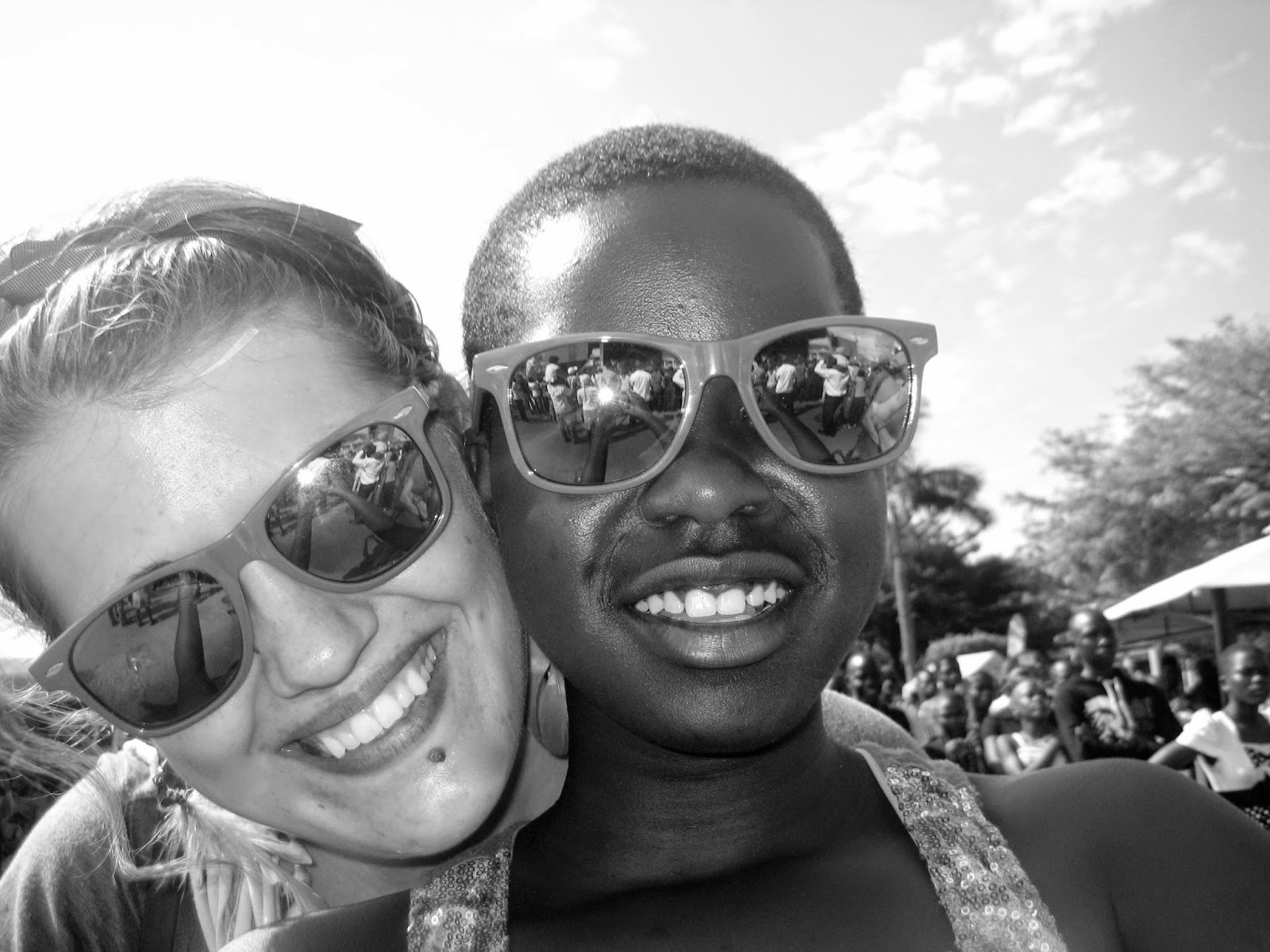
Me and the girls


Me and the boys

As we arrived to the crazy taxi park in costume, we skipped through the streets while vendors tried to sell us sunglasses, pirated DVDs, and sweaters.

Why they sell sweaters in a place where the average temperature is in the 80s will still boggle me.

We made it up to the main event where we were welcomed and out costumes clearly blended in with the crowd.  Music was booming.  Face painting commenced on every corner.  Many wore masks as if we were at a masquerade. 


One of the vehicles that carried dancers was 
transformed into an alligator/crocodile out of sheet metal!

Oh and I know this might seem obvious but because it was a street fair, there were no bikes, bodas, buses, or matatus.  My youth and I danced in one of the busiest intersections of Kampala.  It was superb!


I ended up seeing many familiar faces… From other youth that I work with to artists that I have had the chance to connect with, I finally felt a sense of community. 

32° East, whom we at In Movement share our space with, were showcasing pieces from their month long contemporary art exhibit.  One part of this is the boda project, which transforms these everyday taxis into art.  Examples include one looking like a popcorn kernel that even sold popcorn from the back to another resembling a pineapple and even one that was encompassed in a giant helmet made out of plastic bottles.


One of the bodas from the boda project at 32° East, which 
shows what things Ugandans strap to the back of.  Including cows.

As the sun gave me awkward tan lines, I was quickly reminded how much this country has to offer.  As families traversed through the street with men holding children and women drinking beer, I realized that Uganda will eventually reach gender equality and that art will be accepted. 

It’s days like these that make me want to stay forever.


My girl Sharon who took all the photographs!